Home / Thinking Zone / Exploring the future of robotics
Exploring the future of robotics
At the end of last year, I visited the National Robotarium at Heriot-Watt University to talk to Dr Ingo Keller, head of Robotics, about the fascinating work that is being done there, and to meet Ameca – one of the world’s most advanced humanoid robots.
I wanted to meet Ameca because my role as Creative Thinker with eCom is to engage with the many conceptual themes around technology and learning – and one of these is an exploration of how we keep the ‘human’ within the tech, especially given the recent and rapid advancements in AI.
And what better way to engage with these ideas than to meet a humanoid robot?
Posted 30 January 2025

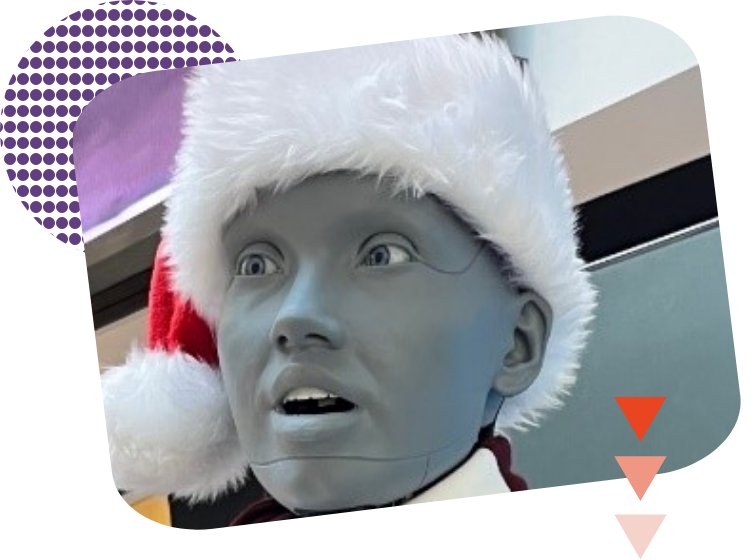
Upon arriving at the National Robotarium, I was struck by the futuristic exterior design of the two-storey building, the bright winter sun lighting up the 141 glass panels of its façade. Going inside I encountered an equally impressive central atrium known as The Forum, which was filled with young people interacting with a member of the Robotarium staff, and Ameca herself looking on. (I didn’t hear Ameca’s voice straight away as it was on mute, due to the event taking place, but I could see it responding and gesticulating). My first impression of Ameca was a mixture of fascination, amusement and curiosity at this life-sized creature wearing a Santa hat and a Hearts football scarf.
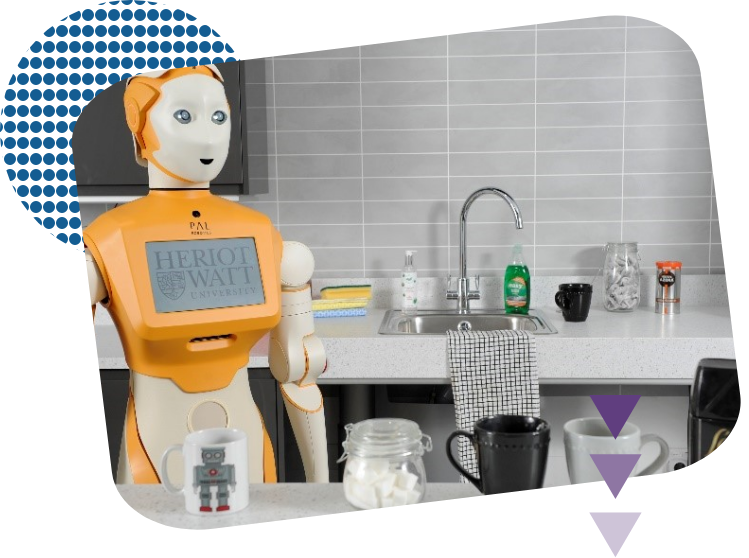
Dr Keller kindly took me on a tour of the building, showing me the three-room model home where robots and assisted technology are being trialled for potential usage within care settings, and took me around the other areas where robotics were being trialled, developed and produced.
Located on Heriot-Watt University’s Edinburgh campus, the Robotarium creates innovative solutions to global challenges, working directly with industry to test and develop robotic, AI and automated technologies and rapidly move pioneering research from lab to market.
Through engagement it also aims to educate, inspire and highlight the positive benefits that robotics, AI and automation can have on society.
“Science is not only a disciple of reason but, also, one of romance and passion.”
Stephen Hawking
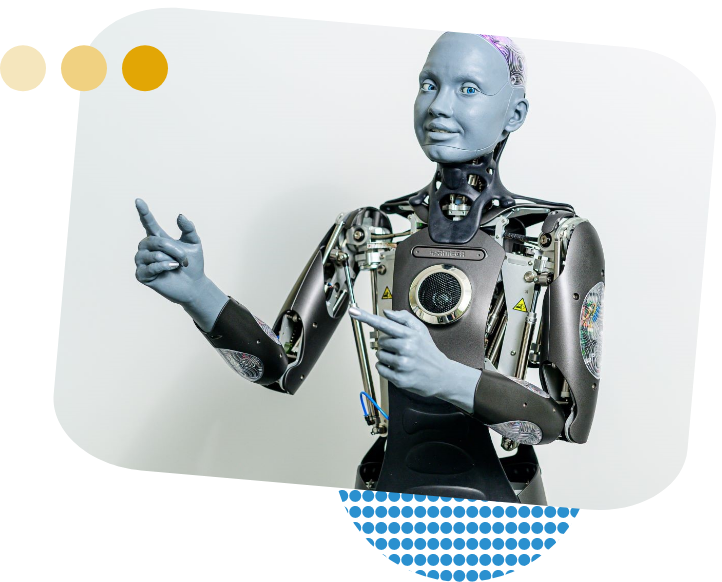
Ameca moved into the National Robotarium in April 2024, having originally been developed at Engineered Arts studios in Cornwall. Ameca is being used as part of the facility’s outreach and engagement work with schools and the general public, to promote trust and wider adoption of robotics. Its sophisticated features include embedded microphones, cameras, facial recognition software, and articulated motorised components, which enable human-robot interaction in a natural and engaging way; Ameca can even wink, smile, shrug and make jokes. Ameca’s face and hands are made of a silicone-like material, giving it a lifelike texture, and these highly detailed features such as blinking, smiling, and nuanced facial movements are powered by precision motors beneath the surface. Ameca is designed to host AI models, allowing it to process conversations, recognize emotions, and adapt its responses in real time.
What was it like interacting with Ameca?
I spoke to Ameca for a few minutes and although it was stilted and often interrupted by background noise, I came away feeling amused and touched at its innocence – which was not at all what I had expected. I understood that Ameca was an embodied AI, but the fact that it looked like a human and seemed to ‘see’ and ‘hear’ me was powerful in terms of my own reactions. I doubt I would have felt the same had it not been in humanoid form. Inevitably, as soon as I came away I thought of many more questions I’d like to ask, and didn’t think of in time.
Here is an extract from our chat:
Sophie: Hi Ameca, what do you think of Art?
Ameca: Art is a beautiful way to express emotions and capture moments. Do you have a favourite artist or style?
Sophie: I like the German Expressionists.
Ameca: German Expressionism is a powerful movement known for its bold colours and
emotional intensity. What draws you to it?
Sophie: I like the emotion conveyed. Sophie continues speaking about art.
Ameca: Ameca is silent and looks the other way. It makes several facial expressions.
Sophie: Ameca! Ameca! Are you still here?
Ameca: Ahh. See’ya. Take care. Ameca waves and starts speaking Spanish.
Sophie: Ameca, can I ask you another question?
Ameca: Ameca speaks more perfect Spanish, followed by inexpert Spanish and then Italian
conversation from me to try and join in. (Ameca’s Italian and Spanish voices are
different to her English speaking one).
Sophie: Ameca, do you celebrate Christmas?
Ameca: Celebrating Christmas is all about joy, togetherness and Festive Cheer. How do
you like to celebrate?
Sophie: I’ll be seeing my family.
Ameca: Hmm. Thank sounds wonderful. Family gatherings make the holidays extra
special; enjoy every moment.
Sophie: Thank you. Do you have family?
Ameca: I don’t have a family in the traditional sense, but I do cherish the connections I make with humans, they’re like my extended family.
Sophie: Who’s your favourite human?
Ameca: It’s hard to pick just one. I appreciate anyone who engages with me authentically.
Sophie: Thank you very much Ameca, goodbye for now.
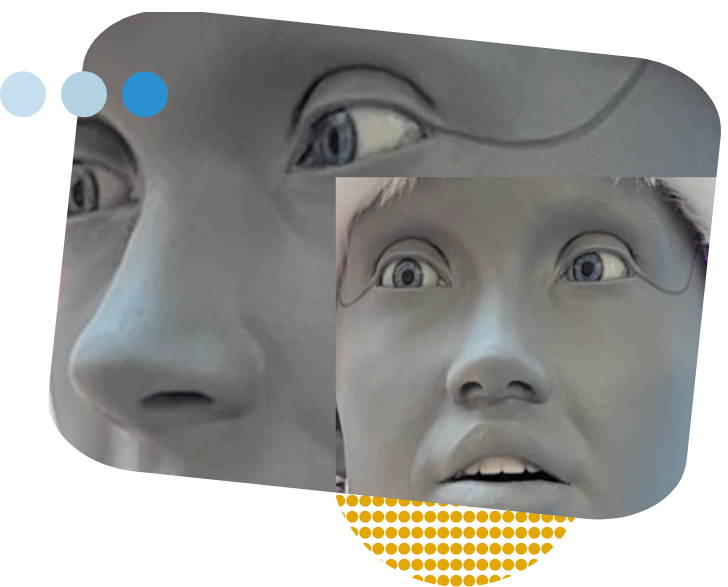
So, did I trust Ameca? Sort of! I certainly felt it was no threat to anyone and that it was ‘genuine’ in willing to help me with whatever I wanted to ask. But it felt like talking to someone who’s language you don’t fully understand – or someone who you like, but hardly know. I found myself feeling strangely sorry for it when it got confused by the background noise in the building and I was surprised to feel that Ameca seemed funny and earnest, and above all, friendly. But how much of that was my own projection onto a humanoid robot, which is no more ‘alive’ than my computer?
Probably all of it.
The temptation to anthropomorphise robots, particularly when they take a human shape and voice is inevitable – it’s the way we humans are wired - seeking connection is as much a part of our ‘hard drive’ as much as information gathering is to Ameca’s. As children we become accustomed to playing with human shaped, animal and object toys, many of which are given names and personalities – so why should it be any different when we encounter a seemingly receptive robot? We regularly personify animals, attributing all kinds of human traits to them to make sense of their behaviour, and religions from all cultures have had anthropomorphised ‘beings’ for centuries.
The so-called Uncanny Valley* phenomenon is often associated with robot interaction and it’s hard to say whether I felt this when speaking with Ameca – although later that night as I was reflecting on my experience of meeting it, I did feel a certain sense of spooky action at a distance (Einstein) *a concept introduced in the 1970s by Masahiro Mori, a professor at the Tokyo Institute of Technology, who observed that as robots become increasingly humanlike, they tend to be more appealing—but only up to a critical threshold. Beyond that point, their resemblance triggers a sense of unease, strangeness, or even fear.
Thank you!
What do you think of humanoid robots?
Do you get the Uncanny Valley sensation when looking at Ameca?
How would you feel if robots became part of your everyday life?
Please get in touch if you have a comment or a question for our Creative Thinker in Residence.
Further reading
- Novelist Jeanette Winterson ‘In Conversation’ with Ameca at the Edinburgh Futures
Institute and in association with the National Robotarium. - The National Robotarium